


Alarms screaming at 5:15 AM. You know the drill. The kitchen counter looks like a hurried catering tent. Two round steel tiffins stuffed with hot ajwain parathas for the kids. An insulated box of dry aloo gobhi and soft phulkas for your partner, who is already checking train indicators on their phone while looking for their wallet. A thermos of warm adrak chai placed quietly beside an ageing parent's bed. And right in the middle of this domestic whirlwind, you glance up at the wall clock, mentally running through third period lesson plans, Class 8 geometry corrections, and a 9:30 AM staff briefing.
The teacher who packs everyone’s tiffin almost always forgets her own. Or she packs it, only to let it sit cold inside a cotton tote bag behind two stacks of board exam practice sheets. When 11:30 AM hits and energy crashes through the floor, nobody sits down to a proper meal. You grab a chipped ceramic cup of over sweetened staffroom chai and chew through two soggy Marie biscuits while standing up, red pen in hand, breaking up an argument between two boys in the back row.
Step into the classroom and you see the exact same story playing out in miniature. A seventh grader is practically melting into their wooden desk during second period geography, eyes glazed over. Why? They missed breakfast because the yellow school bus showed up fifteen minutes early. Now they are trying to understand topographical maps on an empty stomach, or maybe on a handful of extruded, salty puff snacks bought from the tapri outside the school gate.
Whenever exhaustion drags us down, whenever our patience snaps or brain fog makes basic decisions feel impossible, we treat it like a personal character flaw. We tell ourselves to toughen up, brew another mug of coffee, or summon more sheer willpower.
Drop the guilt. Right now. The real problem is rarely a lack of nutritional knowledge. It is a sheer lack of time, workable routines, and realistic support.
Nutrition is not a moral test. It is not an exotic shopping cart filled with imported blueberries, kale powders, or punishing liquid cleanses that make you feel like an alien in your own home. Strip away the wellness marketing and a healthy plate is just daily maintenance. It is fuel. It keeps your joints from aching, keeps your temper steady, and gives you the cognitive bandwidth to handle the people who rely on you every single day.
When your plate is steady, your mind settles down. Let us figure out how to make that happen in real Indian homes without turning dinner into another unpaid job.
1. Beyond the Magic Food Delusion
Modern food culture has a hero complex. Scroll through your phone late at night and within five minutes someone will tell you that warm lemon water with chia seeds melts belly fat while you sleep. Someone else swears raw broccoli balances your hormones, or that eating five soaked badams before an exam turns an average student into a board ranker.
Biology does not work like that. The human body is not a vending machine where you drop in a walnut and out pops genius. It is an intricate, messy biochemical network. Nutrients do not work in isolation. They interact with digestive enzymes, hormone cascades, your vascular system, and trillions of microbes living in your gut. Expecting one trendy superfood to rescue an erratic, high stress lifestyle is wishful thinking.
Look at how the World Health Organization defines a sensible diet. They strip away the glossy marketing and talk about four simple ground rules.
First comes adequacy. That just means eating enough food so your body can actually get through the day without burning itself out. For a school teacher, adequacy is the difference between standing on hard floors for five periods without your lower back screaming, and leaving the school gate feeling like you just survived a marathon.
Second is balance. You cannot run a human engine on pure fast burning carbs without paying for it. If ninety percent of what you eat is refined starch, your blood sugar spikes, crashes, and leaves you cranky before the mid-morning recess.
Third is moderation. This does not mean weighing your food on a jewellery scale or counting every grain of rice. It just means keeping fried street food, bakery fats, and pure table sugar from running your entire kitchen.
Fourth is diversity. No single vegetable or dal gives your body everything it needs. You need different colours, different textures, and different local grains to feed the friendly bacteria living down in your digestive tract.
There is another reality people forget: healthy eating is not one rigid formula. It moves with your life. A sixteen year old playing inter school football needs a completely different plate than a forty five year old checking accounts at a desk. A winter meal in Punjab, heavy with bajra rotis and sarson, makes absolute sense for that climate, just as light fish curries, rice, and coconut work for the heat and humidity of coastal Bengal or Kerala.
When your food fails you, you rarely fall apart instantly. The decline is gradual. That heavy mental sludge where grading ten notebooks takes two hours. A short fuse, where a spilled water bottle feels like an intentional personal attack. A battered immune system that catches every cough floating through the school corridor. Slow moving chronic conditions down the road, including blood pressure creep, insulin resistance, and fatty liver.
A good lunch cannot solve systemic workplace stress. But it gives your body the biochemical baseline needed to survive it.
2. The Teacher’s Double Shift
If you want to understand why teachers and working adults struggle to eat well, look at the cold mechanics of their mornings. Educators carry a workload that few outside the field truly appreciate.
Predawn wake ups start the cycle. Days begin in the dark, balancing domestic chores against strict morning school bells.
Then comes the double caregiving shift. Cooking for others, ironing uniforms, helping with homework, and sorting elder medications before their own commute even starts.
Physical wear takes its toll. Standing on hard terrazzo floors for hours at a stretch, followed by hours hunched over tiny desks marking workbooks.
Heavy executive loads add to the strain. Teaching forty students at once, keeping class discipline, completing administrative ledgers, and answering anxious parents.
Disappearing lunch breaks are the norm. That thirty minute break usually gets eaten alive by playground supervision, sudden staff notices, or a student who needs immediate help.
The staffroom crutch becomes the default solution. Relying on sugary, over boiled chai and packaged biscuits because sitting down to chew real food takes time that simply does not exist.
Look, teachers do not need another lecture on vitamins. They already know an apple beats a packet of fried bhujia. The breakdown is not educational, it is logistical. When you have four minutes between bells, convenience always wins.
When your brain runs on empty or survives on refined flour and pure table sugar, it registers an emergency. That blood sugar plunge triggers adrenaline and cortisol. You get irritable, your working memory shrinks, and you burn out.
Do not blame an afternoon slump entirely on one snack. Look at the whole picture. Food, water, sleep, and physical movement are gears in the exact same machine. Jam one, and the whole system starts grinding.
3. Harvard Meets the Desi Thali
Picture a classic festival thali. A small mountain of white rice, three piping hot puris, a tiny katori of thin dal that is mostly water and yellow tadka, an oily potato sabzi, and a single sad slice of cucumber resting on the rim.
It is delicious, nostalgic, and culturally comforting. But over the last few decades, our daily meals quietly morphed into everyday copies of that festival plate. Wholesome millets, local legumes, and rich wild greens were pushed aside, while polished carbs took over almost the entire thali.
We do not need to download calorie apps that log every gram of jeera. We just need a clear mental picture.
The Half Quarter Quarter model from the Harvard School of Public Health is as simple as it gets.
Half of the plate should be vegetables and fruits. Focus on colour, crunch, and fibre. Regular potatoes and arbi do not count here because their high starch content acts more like a grain than a green.
One quarter of the plate belongs to whole grains. Think whole wheat roti, unpolished rice, jowar, bajra, ragi, or oats.
The remaining quarter belongs to real protein. Thick dal, whole rajma, chana, paneer, eggs, fish, or chicken.
Round it off with a modest spoonful of traditional cold pressed oil or pure ghee, with plain water as your primary drink.
Clearing Up a Common Mix Up
A lot of domestic health articles claim that ICMR says half your daily thali must be salad and fruit, and a quarter must be protein.
That is flatly incorrect. That half and quarter visual comes directly from Harvard.
India’s own premier research body, the Indian Council of Medical Research and the National Institute of Nutrition (ICMR NIN), uses a different, comprehensive model called My Plate for the Day from their Dietary Guidelines for Indians. Built around a 2,000 calorie daily intake, ICMR NIN provides specific daily gram allocations across real food groups: cereals and millets, pulses, milk and curd, green leafy vegetables, other vegetables, fruits, nuts, seeds, and healthy cooking fats.
Instead of enforcing rigid plate geometry, ICMR NIN focuses on dietary diversity. Their clinical message hits home: stop piling up white rice and refined wheat, bring back our regional coarse millets, cook thick dals instead of watery soups, and make sure you hit at least 400 grams of combined vegetables and fruits every day.
Both models arrive at the exact same conclusion: vegetables, lentils, and real whole foods belong at the center of our tables, not as tiny garnishes to a pile of refined grains.
4. Carbs Are Not the Villain
Carbohydrates have become public enemy number one. Open social media and you will see self-proclaimed experts claiming that a single bite of rice or roti triggers instant fat storage. Families are throwing away the very staples their grandparents lived on for generations.
Let us be clear: carbs are not evil. Full stop. It is what we do to them that matters.
Your brain alone burns roughly twenty percent of your body’s daily resting glucose. A teacher explaining linear equations or a student writing an essay needs that glucose to function. Cut carbs out entirely and mental stamina plummets. You get pounding tension headaches, a short temper, and brain fog so thick you cannot find your car keys.
The real difference comes down to the food matrix.
First, you have ultra refined carbs. Maida, white sandwich bread, packaged cream biscuits, instant noodles, sugary breakfast flakes, and bottled colas. These break down into free sugar almost instantly inside your digestive tract. Your blood glucose shoots up, insulin rushes in to clear it, and you crash hard ninety minutes later. That crash is why you feel completely exhausted by 11:00 AM, desperate for another sweet tea.
Then, you have intact, complex carbs. Stone ground whole wheat atta with the bran intact, pearl millet (bajra), sorghum (jowar), finger millet (ragi), rolled oats, unpolished red rice, and whole pulses. These grains remain enclosed in their natural plant cell walls, full of dietary fibre. They digest slowly, releasing glucose into your bloodstream in a calm, steady stream that keeps you alert for hours.
You do not need to banish familiar staples to eat well. No Indian home needs to give up rice or roti. You just need to tweak your plate.
If you love white rice, keep eating it, but match that cup of rice with an equal or larger bowl of thick dal and sautéed sabzi.
Mix coarse jowar, bajra, or ragi flour directly into your daily whole wheat atta to add minerals and fibre without changing your routine.
Trade refined breakfast noodles for a hot bowl of vegetable poha, broken wheat dalia, or soft vegetable upma.
5. The Honest Truth About Protein
Honestly, forget fancy imported protein powders and synthetic shakes. Most people in India do not need a tub of chocolate flavored isolate sitting on their counter. What they actually need to do is stop drinking yellow water and calling it dal.
Look at how dal is cooked in millions of homes. Three tablespoons of toor dal boiled in four cups of water, tempered with a little mustard oil, and ladled out so thin you can see the bottom of the steel katori. That is not a protein dish. That is warm, seasoned water with a sprinkle of grain.
If you want real sustained energy, double the lentils. Make that dal so thick your spoon stands up in it.
Here is how you actually get enough protein without turning your grocery bill upside down.
Stop treating rajma and chole like heavy weekend cheat meals. They are nutrient dense powerhouses. Soak them properly overnight, cook them with plenty of onions, ginger, garlic, and tomatoes, and eat them on Tuesday afternoon. Green moong, black chana, and lobia should be on regular rotation.
Fresh homemade curd is pure gold for both protein and your gut microbiome. Put a big bowl of thick dahi on your plate instead of a watery raita. If you eat paneer, crumble it into your morning paratha dough or pan sear it lightly with turmeric and jeera instead of swimming in restaurant butter gravy.
Sprouting takes zero culinary talent. Put whole green moong or matki in water on Friday morning, drain them on Friday night, leave them in a damp cloth, and by Sunday morning you have living food bursting with bioavailable minerals. Toss them with lime juice, chopped cucumbers, and a pinch of rock salt for an effortless breakfast.
If your family eats non vegetarian food, whole eggs are the cheapest multivitamin on earth. Boil six eggs on Sunday night, leave them unpeeled in the fridge, and you have instant grab and go protein for Monday and Tuesday mornings. For fish eaters, local freshwater fish like rohu or katla, cooked in light homestyle mustard or tomato gravy, provide clean protein and essential omega fats without weighing you down.
The rule is remarkably straightforward: every single time you sit down to eat, ask yourself where the protein is hiding. If all you see is two phulkas and a heap of potatoes, your body will be screaming for food two hours later. Add a cup of thick dal, two boiled eggs, or a bowl of curd, and your energy stays steady until evening.
6. Fat Is Fuel, Not an Enemy
Back in the late nineties, the low fat craze convinced millions of families that dietary fat was dangerous. Kitchens abandoned traditional cold pressed oils for ultra refined oils, and grocery carts filled with fat free packaged snacks that were secretly packed with extra sugar and modified starches to replace the lost taste.
That was a huge misstep. Dietary fat is a biological necessity.
Every single cell in your body has an outer membrane constructed from lipids. Your brain is roughly sixty percent fat by dry weight. Essential vitamins, specifically A, D, E, and K, cannot be absorbed from your gut without fat. Eat a raw carrot with zero fat and your body flushes most of its beta carotene straight out unabsorbed. Fat also slows down gastric emptying, keeping you full and satisfied instead of constantly hungry.
The WHO advice is not to strip out fat, but to choose better sources.
Prioritize good unsaturated fats. Cold pressed mustard oil, groundnut oil, sesame oil, alongside handfuls of walnuts, peanuts, seeds, and local fish. A modest spoonful of traditional pure desi ghee, about one to two teaspoons daily, fits comfortably into a balanced life.
Eliminate industrial trans fats entirely. These are found in commercial vanaspati, cheap bakery patties, margarine, packaged biscuits, and roadside snacks fried in oil reheated ten times over.
You do not need to boil your vegetables in plain water. A traditional Indian tadka made with a small spoon of cold pressed mustard or groundnut oil, sizzling with jeera, rai, hing, and haldi, is not an indulgence. It makes the fat soluble vitamins in your vegetables bioavailable.
7. The 400 Gram Plant Baseline
If you stripped away all the contradictory diet books and kept just one rule, it would be this: eat more real plants.
The WHO recommends at least 400 grams of fruits and vegetables daily, excluding potatoes and other starchy tubers, for everyone aged ten and older. Alongside that, they recommend getting at least 25 grams of naturally occurring dietary fibre daily.
Dietary fibre is not just digestive roughage. It feeds the trillions of microbes living in your large intestine. When those beneficial bacteria ferment fibre, they produce short chain fatty acids that cool systemic inflammation and communicate directly with your brain through the gut brain axis.
You do not need to spend money on imported produce. Walk through your local subzi mandi and look for deep, seasonal color.
Pick up leafy greens like palak, methi, sarson, bathua, drumstick leaves, and chaulai.
Look for rich yellows and oranges like seasonal carrots, pumpkin (kaddu), ripe papaya, and winter oranges.
Bring home vibrant reds like ripe desi tomatoes, fresh beetroot, and pomegranate.
Add deep purples like brinjal, jamun, and purple cabbage.
Do not forget clean whites like mooli, cauliflower, lauki, turai, onions, and garlic.
How do you actually hit that 400 gram mark without overthinking it?
First, sneak veggies into your morning routine. Grate carrots, lauki, or finely chopped palak directly into your paratha dough, chilla batter, poha, or upma.
Second, double your cooked sabzi portion. Dish out cooked vegetables as a primary event on your plate, not a tiny spoonful in the corner.
Third, bring back fresh kachumber. Put a simple bowl of chopped cucumbers, tomatoes, radishes, or grated carrots on the table, tossed with fresh lemon juice, bhuna jeera, and black salt. Eating fresh salad before your main meal helps smooth out post meal blood sugar spikes.
Fourth, choose whole fruit over juices. Pick up a fresh guava, an apple, or an orange instead of drinking strained juice. The whole fruit keeps its natural fibre intact, slowing down sugar absorption.
8. Smart Component Prep for Real Life
Let us address reality: nobody wants to spend three hours cooking after standing on their feet or working at a desk all day.
The secret to sustainable eating in a busy home is not spending your entire Sunday cooking giant batches of food that taste stale by Wednesday. The secret is component preparation, prepping versatile kitchen building blocks that eliminate early morning decision fatigue.
Wash, dry, and chop sturdy vegetables in advance. Keep airtight containers of chopped beans, carrots, and cauliflower in the fridge. They turn into quick stir fries, sabzis, or poha in under eight minutes.
Pre boil legumes over the weekend. Having boiled chana, moong, matki, or rajma ready means you can toss together quick sprout chaats, usal, or curries on busy weeknights.
Keep batter on standby. A tub of idli, dosa, or soaked moong dal batter in the fridge means hot breakfasts and tiffins without morning panic.
Dry roast shelf stable snacks. Toast makhana, chana, and peanuts in a heavy kadai with haldi and rock salt. Keep them in clear glass jars on your counter so healthy snacks are the easiest thing to reach for.
Boil a batch of eggs. Keep unpeeled hard boiled eggs in the fridge for instant breakfast protein, tiffin rolls, or quick dinner curries.
When your alarm goes off on a rushed Tuesday morning, stop wondering what elaborate meal to invent. Assemble using a simple equation: Whole Carb Base plus Dedicated Protein plus Visible Vegetable or Fruit.
Think of vegetable poha loaded with peas and carrots plus a bowl of fresh curd. Whole wheat roti wrapped around spiced paneer, onions, and capsicum plus a seasonal fruit. Vegetable upma plus two boiled eggs. Or a besan chilla packed with grated vegetables plus a mint curd dip.
9. Real World Tiffin Blueprints
A tiffin needs to pass three real world tests: it must hold up at room temperature four hours later, fit into a compact bag, and keep you energized without making you sleepy.
Let us look at practical morning options that actually work in an Indian kitchen.
Vegetable Poha with Spiced Curd. Flattened rice sautéed with mustard seeds, onions, carrots, green peas, crunchy peanuts, and coriander, packed alongside a small box of fresh curd. Slow burning carbs balanced by healthy fats from peanuts and probiotics from curd.
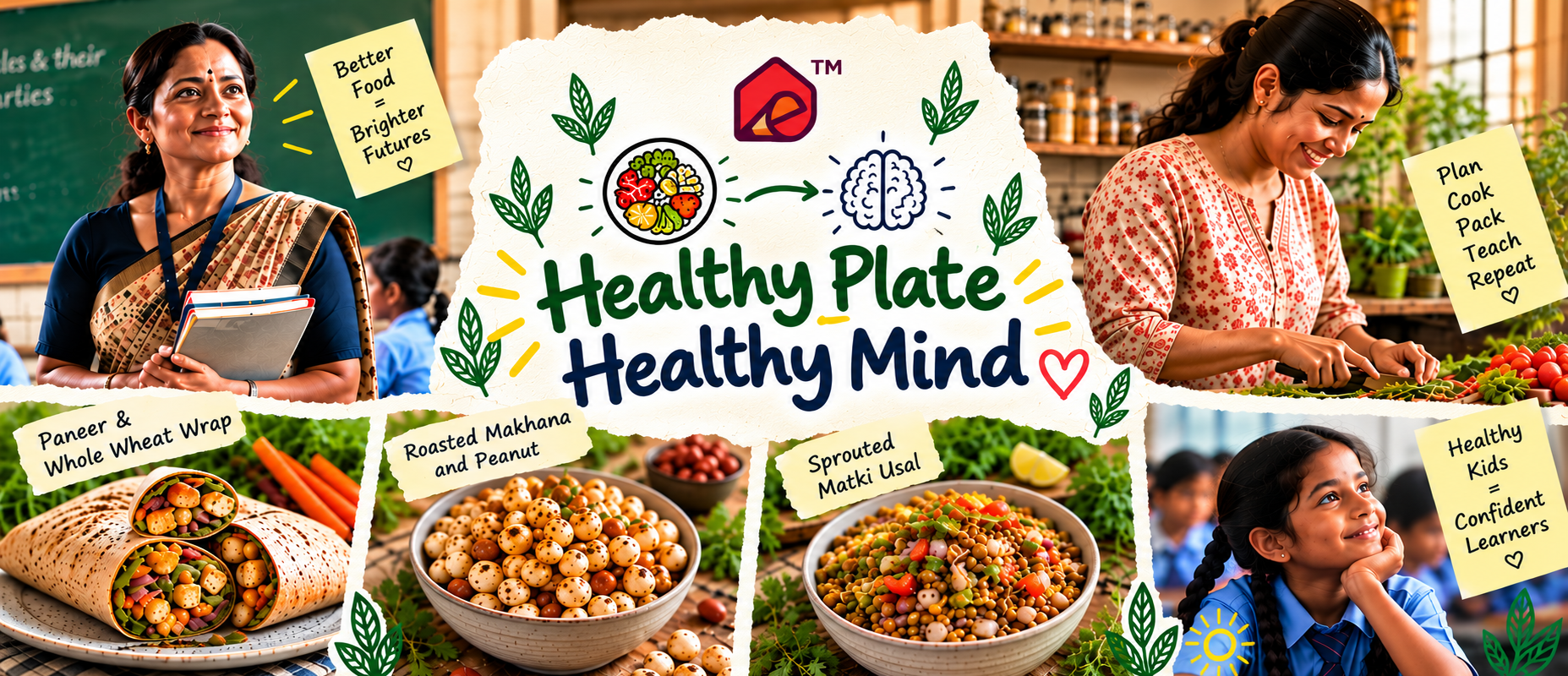
Whole Wheat Paneer Methi Wrap. Soft roti wrapped around fresh grated paneer, tender methi leaves, sliced capsicum, and chaat masala. Calcium, fibre, and steady protein that stays tender inside a steel tiffin box without getting dry or rubbery.
Overnight Rolled Oats and Chia Jar. Rolled oats soaked in milk or curd with chia seeds, topped with chopped local apple, banana, and crushed walnuts. Zero morning cooking required; packed with soluble beta glucan fibre and plant omega fats.
Classic Phulka, Dal, and Kachumber. Two whole wheat phulkas, one bowl of thick yellow toor dal, one bowl of spiced bhindi or green beans, and a small box of sliced cucumbers. This is the traditional meal rebalanced so dal and vegetables match the grain portion.
Sprouted Matki Usal with Multigrain Roti. Sprouted moth beans cooked with ginger, garlic, tomatoes, and fresh curry leaves, packed with jowar or wheat rotis and a wedge of lemon. Packed with natural iron and plant protein.
One Pot Vegetable and Moong Khichdi. Unpolished rice and split yellow moong dal cooked in equal proportions with diced carrots, beans, spinach, and roasted cumin. Gentle on your gut and deeply restorative on overwhelming workdays.
Dry Roasted Makhana and Peanut Bhel. Foxnuts toasted with a dab of ghee, mixed with roasted peanuts, raw onions, tomatoes, green chillies, and lemon juice. A crunchy, low sodium alternative to fried factory chips.
Spiced Bhuna Chana and Fresh Fruit. Whole roasted Bengal gram seasoned with turmeric and rock salt, paired with a whole guava or crisp pear. Completely shelf stable, mess free, and keeps your blood sugar flat and steady all afternoon.
10. The Non Food Trinity: Water, Sleep, and Moving Your Feet
You can eat all the steamed greens and organic lentils you want, but if you are sleeping four hours a night and running entirely on caffeine and anxiety, your body is still going to rebel. Food is powerful, but it does not work in a bubble.
Stop Obsessing Over Eight Glasses
The internet loves telling everyone that they must chug exactly eight to ten glasses of water every day or their brain will shrivel up.
That is nonsense. Hydration is personal. A tall male physical education teacher running drills under the scorching April sun in Nagpur needs way more water than a literature professor sitting under an air conditioner in Bengaluru during December.
Your food contributes water too. A bowl of watery cucumber kachumber, a plate of lauki sabzi, and a cup of chaas all hydrate you.
The practical move is dead simple: keep a clean stainless steel bottle directly in your line of sight. Do not hide it in your bag. If it is sitting on your lecture podium or desk, you will naturally sip it between tasks. If your urine is pale straw, you are fine. If it looks like dark apple juice, drink a glass of water. Done.
Move Between the Bells
Nobody is asking you to wake up at 4:30 AM to hit a crossfit gym for two hours.
The WHO recommends between 150 and 300 minutes of moderate movement a week. Break that down and it is less than thirty minutes a day.
For an educator or office worker, you can collect those minutes in small pockets without changing into running shoes.
Pace the back of the classroom while listening to student presentations.
Take the stairs to the second floor staffroom instead of waiting around for an elevator.
Get off your desk chair every forty minutes. Stand up, roll your shoulders back, stretch your calves, and walk to the end of the hall.
Moving your skeletal muscles pulls glucose out of your bloodstream immediately through an insulin independent pathway. That means a quick three minute walk around the school courtyard after lunch stops you from falling asleep over your marking ledger at 2:00 PM.
Guard Your Bedtime Like Your Life Depends on It
Because frankly, it does.
When you stay up until 1:00 AM grading exams or scrolling short videos, your neurochemistry goes completely haywire. Your body produces excess ghrelin, the hormone that screams for food, while suppressing leptin, the hormone that tells you to stop eating. At the exact same time, morning cortisol spikes.
You wake up feeling groggy, anxious, and biologically driven to seek out high calorie junk. You do not crave a boiled egg or a plate of sprouts after five hours of sleep; you crave sweet sugary chai, buttery white bread, and fried samosas. Sleep hygiene is an indispensable nutrition strategy. Turn off bright phone screens forty five minutes before bed, keep your room cool and dark, and protect seven solid hours of rest.
11. The 3:45 PM Staffroom Raid
Walk into any school staffroom at 3:45 PM. The students have gone home. The final bell has rung. Energy levels across the room are completely depleted.
Suddenly, someone places a fresh packet of deep fried bhujia or spicy mixture on the center table. Within four minutes, half a kilo of fried namkeen has vanished. Nobody even remembers picking up a handful.
Why does that happen?
It is not because teachers are weak willed or lack self-control. It is because their brains are exhausted. Highly palatable foods loaded with refined salt, sugar, and industrial fats trigger a fast release of dopamine in the brain reward pathways. In that moment of intense fatigue, crunching through salty fried dough feels like a fast, soothing band aid for an overtaxed nervous system.
Do not beat yourself up. Just introduce a gentle, intentional pause.
Try this simple mental routine:
First, stop. Step back from your desk. Put the red grading pen down.
Second, look. Actually look at what you are about to eat. Notice the oil, the colour, and the texture.
Third, breathe. Take two long, slow breaths from your belly. Let your shoulders drop away from your ears.
Fourth, eat. If you decide to eat it, chew it slowly. Really taste the salt, the spices, and the oil instead of swallowing it like a pelican while typing an email.
Fifth, notice. Check in with your stomach after three bites. Are you actually hungry, or are you just seeking relief from the day?
If you realize you are eating purely out of mental exhaustion, give your body what it really needs. Step outside into the sunlight for three minutes. Wash your face with cold water. Drink a full glass of water. Give your nervous system a minute to breathe.
12. The Magic of One Family Table
In modern urban homes, dinner has quietly disintegrated. The kids eat at 7:30 PM watching animated videos on a tablet. The parents eat at 10:00 PM balancing a plate on their knees while answering work emails on a glowing laptop. The grandparents eat in their room with the television blaring.
We have lost the anchor of the shared table, and research shows our health is paying a price.
A comprehensive meta-analysis looking at 57 studies and more than 203,000 people found that regular family meals are consistently linked to better dietary quality, higher intake of fruits and vegetables, and lower rates of childhood obesity. A wider review of 41 systematic reviews showed that sharing meals strengthens family communication, improves adolescent emotional resilience, and builds balanced relationships with food.
Now, let us be realistic: nobody has the time to cook three completely different gourmet meals to please a picky eight year old, a busy forty year old, and an elderly parent with digestion issues.
Do not do that. Cook one versatile base meal and customize the toppings.
Take a basic pot of vegetable moong khichdi.
For the child, serve a gentle portion with mild spices, an extra dollop of cooling curd, and a small spoon of desi ghee.
For the working adult, serve a standard portion loaded up with a big side bowl of crunchy cucumber tomato kachumber and a roasted papad.
For the grandparent, cook it slightly softer so it is easy on dental work and gentle on digestion, topped with a warm cumin tadka and fresh dahi.
One pot on the stove. One clean up session. One table where everyone sits together, leaves their phones in the other room, and actually talks to each other.
13. Two Things the Internet Gets Completely Wrong
If you spend any time online, you will run into two massive nutrition traps that cause unnecessary panic: high blood pressure advice that sounds like punishment, and wild claims about balancing your hormones with exotic seeds.
Let us separate the clinical facts from the social media fiction.
The Real Deal on High Blood Pressure
Hypertension is rightfully called a silent killer because it creeps up without a single headache or warning sign. The WHO tells us that adults should keep their salt intake below 5 grams a day, which is roughly one level teaspoon.
Now, when people hear that, they panic. They think they have to eat boiled, unseasoned vegetables for the rest of their lives.
That is absurd. The problem in the Indian diet is almost never the pinch of salt you throw into your fresh bhindi or dal. The real sodium bomb comes from the processed sides we mindlessly consume.
Store bought achar uses salt as a heavy chemical preservative.
Fried papads and market namkeens come dusted in sodium rich spice powders.
Instant soup packets, bottled ketchups, and packaged noodles hide massive amounts of salt behind synthetic flavor enhancers.
The clinically proven DASH eating plan does not tell you to eat tasteless food. It simply tells you to load up on potassium from vegetables, fruits, and beans while cutting out industrial salt. Cook with fresh ginger, garlic, jeera, fresh coriander, mint, and a good squeeze of fresh lemon juice. Your tongue will be thrilled, and your blood vessels will thank you.
The Hormone Balancing Myth
Let us talk about the endless parade of detox juices, seed cycling routines, and magical supplements claiming to cure hormonal imbalances.
Hormonal imbalance is not a single medical condition. It is a broad umbrella term thrown around to sell products. Polycystic ovary syndrome (PCOS), hypothyroidism, Hashimoto disease, perimenopause, and type 2 diabetes are completely distinct endocrine conditions. Each has different genetics, different blood markers, and different medical protocols.
Eating plenty of fibre, getting enough protein, and avoiding refined sugar helps regulate your blood sugar and improves your insulin sensitivity. That is fantastic support for conditions like PCOS. But food is a supportive lifestyle partner to medicine, not a magical wand that replaces an endocrinologist. If you suspect your thyroid is sluggish or your cycles are erratic, get real blood work done with a qualified physician. Do not try to treat an endocrine condition with a celery smoothie you saw on an app.
14. What to Do with Ultra Processed Foods
Walk down any supermarket aisle today and you will notice that almost eighty percent of what is sold does not rot. It can sit on a shelf for eighteen months without changing its texture.
These are ultra processed foods, engineered in laboratories with precise ratios of sugar, refined starch, artificial flavorings, and industrial fats to hijack your brain's satiety signals.
The ICMR NIN 2024 guidelines are very clear about this: Indian households need to dramatically reduce their consumption of foods high in fat, sugar, and salt.
Here is what realistic, everyday swaps look like in practice:
Swap packaged cream biscuits for roasted bhuna chana mixed with peanuts.
Swap commercial potato chips for dry roasted spiced makhana.
Swap tetra pack fruit juice for a whole fresh orange, guava, or pear.
Swap instant packaged noodles for vegetable loaded poha or upma.
Swap sweet bakery patties for a homemade paneer or egg roll.
The goal here is never pure perfection. If you are traveling on a highway and the only thing available is a packet of biscuits, eat them and move on with your life. The real goal is making sure that minimally processed, home cooked foods form the daily foundation of your existence, keeping industrial snacks as rare exceptions rather than your default breakfast.
15. Busting Common Food Myths
Myth: Skipping breakfast is the best way to drop weight.
Reality: Skipping breakfast usually leads to ravenous rebound hunger by late afternoon, causing you to overeat sugary snacks or gorge at dinner. What matters is your overall food quality and total daily energy balance.
Myth: Healthy eating is too expensive for normal working families.
Reality: Whole lentils, local seasonal vegetables, unpolished regional millets, peanuts, and eggs are among the cheapest, most nutrient dense foods on the planet. You do not need to buy imported olive oils or quinoa to be healthy.
Myth: Strained fruit juice is just as healthy as whole fruit.
Reality: Straining juice strips away all the intact plant fibre, leaving you with a glass of concentrated fructose that enters your bloodstream in minutes. Whole fruit gives you slow burning energy, chewing satisfaction, and keeps your gut bacteria fed.
Myth: You have to follow a strict named diet to see results.
Reality: Any diet that makes you feel miserable, isolated, or guilty is completely unsustainable. Real wellness is built on adequacy, balance, moderation, and diversity, not rigid rules or cutting out entire food groups.
Myth: Preservatives in food directly cause wild mood swings.
Reality: While a diet packed with ultra processed junk correlates with poorer mental well being over time, scientific evidence does not show that single preservatives directly cause acute mood swings.
Myth: Eating fat will automatically give you heart disease.
Reality: Your body desperately needs healthy fats from cold pressed seed oils, nuts, and fish to build cell membranes and absorb essential vitamins. It is industrial trans fats and excessive saturated fats paired with refined carbs that cause cardiovascular damage.
16. The Classroom Ripple Effect
Classrooms share an emotional and physical climate. When a teacher walks into first period completely depleted, running on three hours of sleep and an empty stomach, their patience is razor thin. Minor behavioural issues feel like personal insults.
When a student sits at their desk undernourished, their brain simply cannot process curriculum material.
UNICEF identifies the years between five and nineteen as an indispensable second window of physical growth and cognitive development. Brain function, emotional regulation, and learning are inseparable from what a child eats.
Wholesome food supplies the physical bricks and mortar needed for growing skeletal tissue and organs.
Steady blood sugar keeps executive focus, working memory, and mood stable through long school periods.
Adequate nutrition allows kids to run, play sports, and develop social skills without collapsing into lethargy.
A child cannot learn fractions or write an imaginative paragraph when their stomach is rumbling, their blood sugar is crashing, or they are suffering from undiagnosed iron deficiency anaemia.
A thorough systematic review looking at 45 studies on breakfast and cognitive performance found consistent proof: children and teenagers who eat a balanced, nutritious breakfast show sharper attention, better memory recall, and faster mental processing compared to those who routinely skip it.
For adolescent students, especially young girls dealing with growth spurts and menstruation, iron requirements jump significantly. Bringing familiar iron rich foods into the home rotation, such as toor dal, kala chana, spinach, millets, sesame seeds, and eggs (paired with Vitamin C rich foods like lemon or amla to boost iron absorption), is essential for fighting off chronic school fatigue.
Teachers and Students Face the Same Battle
Stamina needs run parallel. Teachers need steady energy to stand, lecture, and manage classes for hours; students need steady energy to absorb lessons and grow physically.
The morning rush affects both sides. Teachers skip meals to pack tiffins for everyone else; students skip breakfast because the school bus arrives early.
Snack temptations are everywhere. Teachers default to sugary staffroom tea and biscuits; students reach for packaged crisps and sweetened drinks at the school gate.
The water problem is universal. Teachers forget to drink water to avoid bathroom trips during lectures; students forget their water bottles in their backpacks.
Everyday examples matter. Teachers who drink water, eat a real tiffin, and speak respectfully about food quietly show their students how to treat their own bodies with care.
Educators do not need to become clinical dietitians. But by carrying a reusable water bottle, eating a real lunch without complaining about calories, avoiding using chocolates as rewards or punishments, and normalizing whole foods in the classroom, they become powerful role models for their students.
17. The School Food Environment
Nobody eats in a bubble. A child or teacher's daily choices are heavily shaped by the physical environment they step into every single morning. Kids spend the vast majority of their waking hours inside school gates, making educational campuses one of the most vital public health settings in the country.
The WHO strongly advocates for a whole school approach to nutrition. This means looking past simple classroom health lectures and paying attention to the real environment.
Examine what kinds of foods are being prepared, sold, and promoted inside school canteens.
Ensure clean, safe, free drinking water is physically available across the campus.
Make sure students are given enough time to sit down, chew their food, and finish their tiffins without being rushed back to their desks by a bell.
Keep aggressive marketing of ultra processed, high sugar snacks away from school gates.
In India, this institutional reality is tied to the PM POSHAN scheme, formerly known as the Mid-Day Meal Scheme, which feeds over one hundred million school children every day.
A comprehensive 2024 systematic review covering 31 research studies on India's school meal system revealed vital truths.
Having guaranteed access to a hot, freshly cooked school meal leads to better school enrolment, higher daily attendance, and lower dropout rates, especially among young girls and economically vulnerable communities.
While the link between midday meals and standardized test scores is complex and shaped by teaching quality and classroom infrastructure, the programme provides an indispensable nutritional safety net. For millions of growing children, that school plate is their primary source of daily protein, iron, and key minerals.
When school leadership, educators, and parent committees work together to clean up school canteens, replacing sweet sodas and deep fried chips with cold chaas, fresh seasonal fruits, roasted peanuts, and freshly cooked vegetable dishes, they protect the health and minds of the next generation.
18. Surviving Exam Season
Few periods in an Indian home bring as much acute anxiety as examination season. Board exams, college entrance tests, and finals disrupt family life completely.
Students stay up studying until 3:00 AM, leaning on sweet instant coffee, commercial energy drinks, or biscuits to stay awake.
Physical movement drops to absolute zero as kids stay glued to their study chairs for ten to twelve hours straight.
Meal routines fall apart, with meals delayed or skipped entirely.
Digestion takes a hit, bringing complaints of acidity, bloating, constipation, and nervous stomach aches.
When mental demands double, the brain needs cleaner, steadier fuel than ever before. Getting through exams without burning out means defending three basic habits: steady blood sugar from whole meals, short movement breaks to get blood flowing, and protected nighttime sleep so the brain can store what it learned.
Three Rules for Exam Days
Ditch the sugar crash. Sweet energy drinks and chocolates cause a rapid insulin surge followed by a sudden blood sugar drop ninety minutes later. That crash leaves a student fighting heavy eyelids right in the middle of a study session. Trade them for roasted peanuts, walnuts, bhuna chana, or a bowl of fresh curd with sliced bananas.
Drink water to protect memory. Even a small fluid drop can trigger headaches and slow down memory recall. Keep a steel jug of fresh water on the study desk, tossed with a few mint leaves or a slice of lemon.
Protect sleep to lock in facts. Pulling an all-nighter before an exam is counterproductive. The brain needs deep, slow wave sleep to process facts and store them into long term memory networks. Robbing yourself of sleep to gain two extra study hours leaves your prefrontal cortex sluggish when you sit down in front of the actual question paper.
19. A 5 Day Indian Meal Planning Blueprint
To help put these ideas to work without stress, here is a practical, five day blueprint built for busy working families. Every meal uses normal, easily available ingredients, keeps morning prep short, and brings together whole grains, real protein, and colourful vegetables.
Monday: Starting Steady
Breakfast: Hot vegetable poha cooked with finely diced carrots, green peas, onions, and crunchy peanuts, served with a bowl of fresh curd.
Teacher or Office Tiffin: Two whole wheat phulkas, a bowl of thick toor dal tempered with hing and jeera, seasonal bhindi sabzi, and crisp cucumber tomato kachumber.
Student Tiffin: Soft whole wheat wraps filled with spiced paneer and spinach, packed with a crunchy apple or pear.
Evening Snack: Spiced roasted makhana and a cup of unsweetened ginger tulsi tea.
Family Dinner: Comforting one pot moong dal and vegetable khichdi with a small spoon of desi ghee, roasted papad, and fresh dahi.
Tuesday: Energy and Staying Power
Breakfast: Protein rich moong dal chilla mixed with grated carrots and fresh coriander, served with homemade mint chutney and curd.
Teacher or Office Tiffin: Brown or unpolished rice with thick homestyle rajma masala, steamed French beans, and a wedge of lemon.
Student Tiffin: Soft steamed idlis with thick vegetable sambar loaded with drumsticks, carrots, and pumpkin.
Evening Snack: A handful of roasted bhuna chana and a sweet seasonal orange.
Family Dinner: Warm jowar or whole wheat rotis, sprouted matki usal, sweet yellow pumpkin sabzi, and a glass of fresh chaas.
Wednesday: Midweek Momentum
Breakfast: Overnight rolled oats soaked in milk or curd with chia seeds, topped with chopped walnuts and sliced banana.
Teacher or Office Tiffin: Sprouted green moong chaat tossed with chopped cucumbers, tomatoes, and chaat masala, paired with two soft phulkas and lauki sabzi.
Student Tiffin: Whole wheat vegetable and boiled egg (or crumbled paneer) sandwich with fresh mint chutney, packed with fresh papaya cubes.
Evening Snack: Fresh homemade buttermilk tempered with curry leaves and roasted jeera.
Family Dinner: Fragrant vegetable pulao packed with green peas, carrots, and soya chunks, served with cucumber raita and thick dal tadka.
Thursday: Focus and Fullness
Breakfast: Savoury broken wheat vegetable dalia cooked with finely chopped vegetables, served with a boiled egg or a cup of set curd.
Teacher or Office Tiffin: Methi theplas paired with a bowl of thick chana dal and a side of sliced fresh radish.
Student Tiffin: Mini vegetable uttapams made with fermented batter, served with fresh coconut chutney and sliced guava.
Evening Snack: Roasted pumpkin and sunflower seeds mixed with crunchy unsalted peanuts.
Family Dinner: Two whole wheat rotis, fresh paneer bhurji (or tofu bhurji) cooked with capsicum and tomatoes, and a light bowl of clear vegetable soup.
Friday: Finishing Strong
Breakfast: Warm ragi porridge cooked with milk, a touch of jaggery, and crushed almonds, or savoury ragi upma with seasonal vegetables.
Teacher or Office Tiffin: Two multigrain rotis, thick masoor dal, sautéed cabbage peas sabzi, and a cup of fresh set dahi.
Student Tiffin: Sprouted moong and vegetable frankie rolled in a soft phulka with mild mint spread.
Evening Snack: Dry roasted peanut and puffed rice bhel tossed with fresh coriander, onions, and lemon juice.
Family Dinner: Steamed rice, light homestyle fish curry (or hearty chole for vegetarians), accompanied by stir fried green leafy sabzi.
20. Quick Everyday Recipes You Can Actually Cook
These dependable recipes take less than fifteen minutes of active cooking, use basic pantry staples, and hold up well in a school or office tiffin.
1. Spiced Paneer and Vegetable Whole Wheat Wrap (Prep time: 10 mins)
What you need: 1 leftover or freshly rolled whole wheat roti, 60g fresh malai paneer (or firm tofu) cubed small, half sliced capsicum, half sliced red onion, 1/4 tsp haldi, 1/2 tsp roasted jeera powder, a pinch of chaat masala, 1 tbsp mint coriander curd chutney.
How to make it:
Heat half a teaspoon of mustard or groundnut oil in a pan. Sauté the sliced onions and capsicum on high heat for 90 seconds until slightly blistered but still crunchy. Toss in the paneer cubes, haldi, jeera powder, and salt. Cook gently for two minutes until warm through. Spread the mint coriander chutney over the roti. Spoon the hot paneer vegetable filling down the middle, dust with chaat masala, roll tightly, and wrap in parchment paper.
2. Roasted Makhana and Peanut Bhel (Prep time: 5 mins)
What you need: 2 cups phool makhana, 2 tbsp raw peanuts, 1/2 tsp desi ghee, 1/4 tsp haldi, 1/4 tsp kala namak, half finely diced cucumber, half diced tomato, 1 green chilli (optional), juice of half a lemon, chopped fresh coriander.
How to make it:
Heat ghee in a heavy kadai. Add raw peanuts and roast on medium flame until fragrant. Add makhana and haldi; roast on low heat for 4 to 5 minutes until crisp. Let the mixture cool slightly. Toss into a bowl with diced cucumber, tomato, green chillies, coriander, kala namak, and fresh lemon juice. Eat right away as a crunchy, healthy snack.
3. Protein Rich Moong Dal Chilla (Prep time: 8 mins with pre soaked dal)
What you need: 1 cup yellow moong dal (soaked for 2 hours and ground with ginger and green chillies into a smooth batter), half cup finely grated carrots, 1/4 cup chopped fresh coriander, salt to taste, 1/2 tsp ajwain.
How to make it:
Stir the grated carrots, fresh coriander, ajwain, and salt directly into the ground moong dal batter. Heat a tawa. Brush lightly with oil or ghee, pour a ladle of batter, and spread outward into a medium thick pancake. Cook on medium heat for two minutes until the bottom turns golden; flip and cook the other side for another minute. Serve hot with fresh curd or mint chutney.
4. Vegetable Moong Khichdi (Prep time: 12 mins in pressure cooker)
What you need: Half cup unpolished rice, half cup yellow moong dal, 1 cup chopped mixed vegetables (carrots, beans, green peas), 1 tsp jeera, 1 slit green chilli, pinch of hing, 1/2 tsp haldi, 1 tsp ghee, salt to taste.
How to make it:
Wash rice and dal together. Heat ghee in a pressure cooker and add jeera and hing. Add the chopped vegetables, green chilli, and haldi. Sauté for one minute. Add the washed dal, rice, salt, and three cups of water. Pressure cook for three whistles on medium flame. Serve warm with a bowl of fresh curd.
5. Sprouted Matki Usal (Prep time: 10 mins)
What you need: 2 cups sprouted moth beans (matki), 1 finely chopped onion, 1 chopped tomato, 1/2 tsp mustard seeds, 8 to 10 curry leaves, 1/2 tsp haldi, 1 tsp coriander powder, 1/2 tsp garam masala, salt to taste, 1 tsp oil.
How to make it:
Heat oil in a pan; add mustard seeds and curry leaves until they crackle. Add chopped onions and cook until soft, then stir in chopped tomatoes, haldi, coriander powder, and garam masala. Add the sprouted matki, salt, and half a cup of water. Cover and simmer on low heat for 6 to 8 minutes until tender. Finish with fresh coriander and a squeeze of lemon juice.
21. The 7 Day Healthy Plate Reset
Real, lasting change happens through small, steady daily actions. Try this gentle, one week reset designed for busy professionals, educators, and families:
Day 1: Drink Mindfully. Carry a dedicated, filled water bottle with you to your desk, staffroom, or classroom. Take deliberate sips between tasks and classes. Notice how keeping water right in front of you prevents those afternoon headaches.
Day 2: Add One Plant. Add one visible serving of vegetables or seasonal fruit to your lunch or breakfast box. Grate a carrot into your roti dough, slice a cucumber into your bag, or pack a fresh orange. Do not worry about changing everything else today.
Day 3: Take Movement Breaks. Take two 5 minute movement breaks during your workday. Stretch your calves, roll your shoulders, or take a brisk walk down the corridor instead of sitting continuously. Notice how quickly that neck stiffness eases up.
Day 4: Eat One Meal in Silence. Eat at least one meal without any screens. Put your phone away, close your laptop, push your papers aside, and pay attention to the taste and aroma of your food. Chew slowly and notice when you feel naturally full.
Day 5: Prep an Emergency Snack. Make one healthy whole snack ahead of time. Roast a jar of makhana, bhuna chana, or peanuts and keep it in your drawer to replace packaged biscuits. Share a handful with a colleague.
Day 6: Protect Your Bedtime. Set a firm bedtime tonight. Turn off bright digital screens 45 minutes before sleep and aim for at least seven hours of real rest. Notice how your morning cravings change when you wake up refreshed.
Day 7: Sit Down Together. Sit down for a shared family dinner at the table. Cook one common base meal, adjust the sides for young and old, and enjoy your food together without screens. Celebrate the small, practical changes you made this week.
Nourishing the Person Behind the Work
At the end of an exhausting week, it is easy to see food as just another chore, another meal to cook, another tiffin box to scrub, another task on a never ending domestic list.
Take a breath and step back.
A healthy plate is not about chasing an impossible standard of dietary perfection. It is not about feeling guilty over a hot jalebi at a wedding, an evening samosa with a colleague, or a slice of birthday cake with your child.
It is about something much deeper and kinder: sustaining the person behind the daily work.
When you pack a nourishing lunchbox for yourself before heading out into the morning rush, you are recognizing that your energy, your health, and your peace of mind matter just as much as the responsibilities you carry.
When you sit down with your students or family to share a wholesome, home cooked meal without distractions, you are building a positive, healthy relationship with food that lasts a lifetime.
Build your plate with colour. Add your protein with care. Drink your water, move your body, protect your sleep, and sit down to enjoy your food with a calm, grateful mind.
Your mind, and everyone whose life you touch, will feel the difference.


